Higher Education in the Digital Age by Bowen William G. Guthrie Kevin M
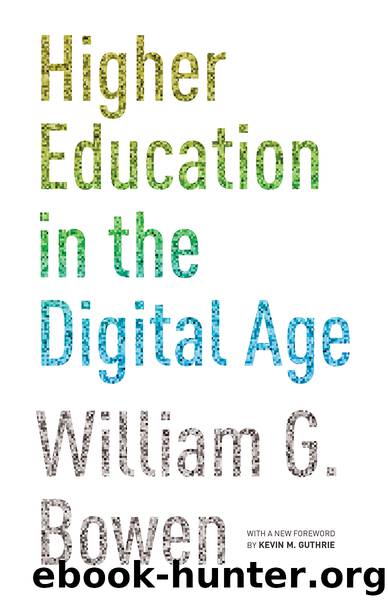
Author:Bowen, William G., Guthrie, Kevin M. [Bowen, William G., Guthrie, Kevin M.]
Language: eng
Format: epub, mobi
ISBN: 9780691159300
Publisher: Princeton University Press
Published: 2013-11-23T08:00:00+00:00
Discussion by Howard Gardner
I AM HONORED to have been invited to comment on Bill Bowen’s first Tanner Lecture. The lecture is witty, insightful, authoritative. I had the privilege of reading the lecture in draft form and I can assure you that it contains an entire education about the financing of universities. In fact there is an additional education in the endnotes alone, more than seventy-five of them.
During the 2012 presidential election, Big Bird was in the news. Whether or not you were a regular viewer of Sesame Street, you probably know the game featured there: “One of these things is not like the others, one of these things just doesn’t belong.” As I read through Bill’s learned lecture, I kept hearing this musical refrain.
I heard this lingering melody because, unlike Bill Bowen and John Hennessy, I have not been a respected president of a major university. Truth to tell, except for my own small research group, I’ve never run anything! In fact, come to think of it, I’ve never even been asked to run anything—let alone a flagship university like Princeton or Stanford.
To add insult to injury, I am not in any sense an expert on the financing of universities, on cost and productivity. What I know is what I read in the New York Times and what I learned from Bill Bowen’s text and footnotes. And so I am not going to take your time simply paraphrasing, if not bundling or bungling, his address.
Now that I have confessed to my disqualifications, let me attempt to atone.
My remarks today are bookended by conversations with two very bright and very self-confident recent young graduates.
Graduate #1 came to see me. I’ll call him Jerry. Jerry announced that he had just completed an educational intervention that had “transformed” the secondary schools in a developing country. Now, he indicated, he wanted to transform collegiate education in America. “Dr. Gardner,” said Jerry, “colleges and universities in America now cost over $50,000 a year. No one can or should lay out that huge sticker price. And so I am creating a system where high school graduates can get a first rate college education … for $5,000 a year.”
I listened for a while and then said, “Jerry, there’s one thing you haven’t talked about yet. Is this college of the future going to be simply a gathering place for people who already live in an area like metropolitan Boston or San Francisco, or will it be residential for students from all over the country and the world?”
Jerry paused for a moment before he confessed, “Gee, I hadn’t thought of that.”
I want to speak today about residential education: the cons, the pros, its possibilities, single and collaborative, local and global.
Even when I went to college, Harvard College, over fifty years ago, we used to joke that we did not need faculty or courses. All we needed were our peers, who, needless to say, were as brilliant and talented as we deemed ourselves to be—our peers and Widener Library.
Download
Higher Education in the Digital Age by Bowen William G. Guthrie Kevin M.mobi
This site does not store any files on its server. We only index and link to content provided by other sites. Please contact the content providers to delete copyright contents if any and email us, we'll remove relevant links or contents immediately.
The Art of Coaching Workbook by Elena Aguilar(51198)
Trainspotting by Irvine Welsh(21665)
Twilight of the Idols With the Antichrist and Ecce Homo by Friedrich Nietzsche(18632)
Fangirl by Rainbow Rowell(9249)
Periodization Training for Sports by Tudor Bompa(8271)
Change Your Questions, Change Your Life by Marilee Adams(7780)
This Is How You Lose Her by Junot Diaz(6886)
Asking the Right Questions: A Guide to Critical Thinking by M. Neil Browne & Stuart M. Keeley(5775)
Grit by Angela Duckworth(5614)
Red Sparrow by Jason Matthews(5472)
Paper Towns by Green John(5190)
Room 212 by Kate Stewart(5120)
Ken Follett - World without end by Ken Follett(4731)
Housekeeping by Marilynne Robinson(4447)
The Sports Rules Book by Human Kinetics(4386)
Papillon (English) by Henri Charrière(4274)
Double Down (Diary of a Wimpy Kid Book 11) by Jeff Kinney(4271)
The Motorcycle Diaries by Ernesto Che Guevara(4098)
Exercise Technique Manual for Resistance Training by National Strength & Conditioning Association(4071)
